Skip to content

AI copilot for chemistry R&D

Design better chemistry, faster — with you in control.

InFLOWS AI is designed to help chemists and materials scientists plan synthetic routes, weigh greener reagent swaps and find what their own lab already knows — as suggestions you review, never as automatic actions.

  • Your data stays yours
  • Human-in-the-loop
  • No auto-execution
Abstract 3D illustration of glowing molecular structures connected by flowing reaction pathways

DesignFLOW · concept view

  1. 1Target
  2. 2Disconnect
  3. 3Rank routes
  4. 4You review

Product modules

Three flows, one copilot

Each module focuses on one part of everyday R&D work. Use one, or move between them as an idea becomes an experiment.

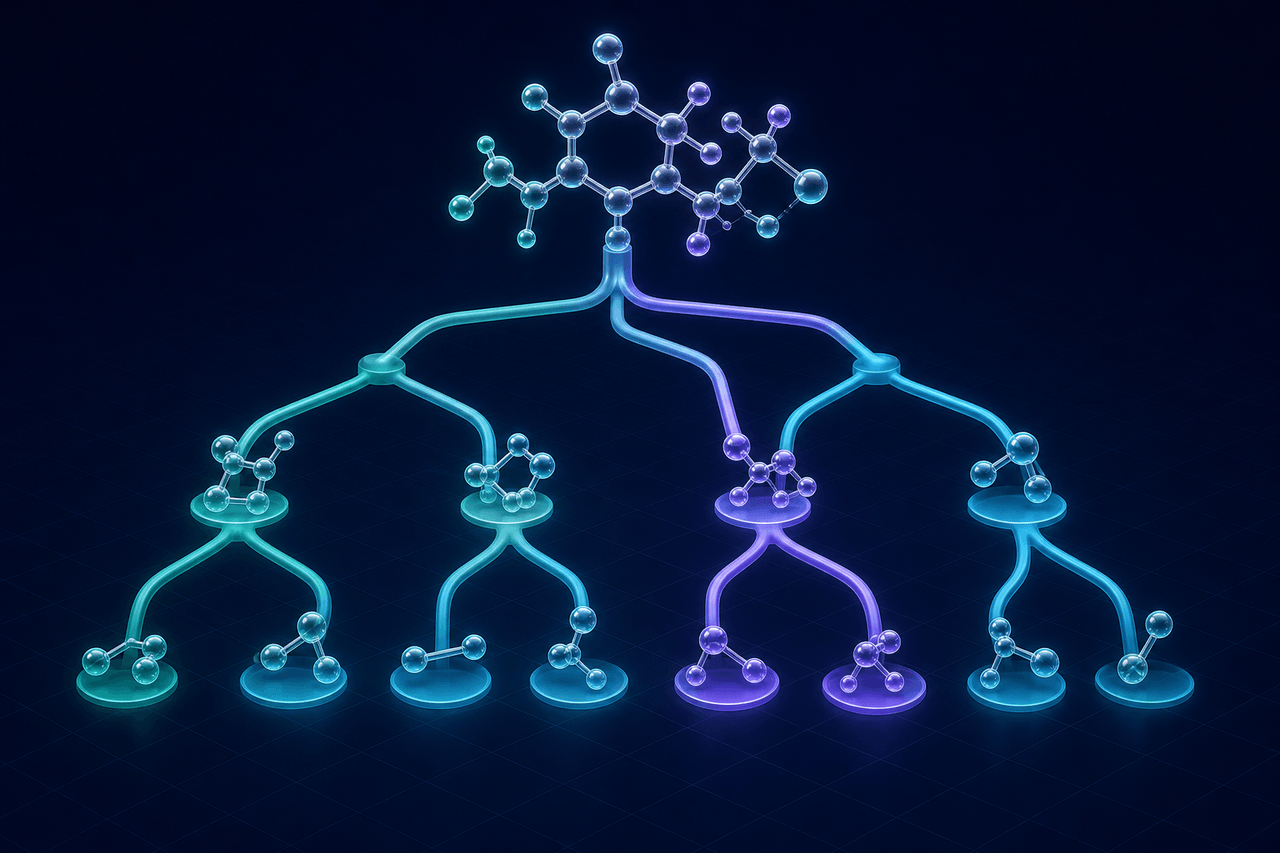
Illustration of a branching retrosynthesis tree of glowing molecular nodes

Retrosynthesis & route design

DesignFLOW

Start from a target structure and explore candidate disconnections and multi-step routes. DesignFLOW is designed to lay options side by side — step count, starting-material availability, known hazards — so you can compare and choose.

  • Multiple candidate routes, not one answer
  • Rationale shown for each step
  • Export to your ELN or a review doc
Illustration of two glass flasks exchanging glowing particles along a curved arrow

Reaction & reagent swaps

SwapFLOW

Ask for alternatives to a reagent, solvent or condition. SwapFLOW helps you surface greener, safer or more available options and flags the trade-offs a chemist would want to check before trying them.

  • Solvent and reagent alternatives
  • Safety and sustainability notes
  • Trade-offs flagged, not hidden
Illustration of an open lab notebook whose pages lift into a constellation of linked data points

Lab-notebook knowledge assistant

CoChemist

Ask questions in plain language across your own notebooks, reports and procedures. CoChemist is designed to answer with citations back to the source entry, so the knowledge your team built is easy to find again.

  • Answers cite your own entries
  • Scoped to your workspace only
  • Works with the formats you already keep

How it works

From question to bench-ready plan

A short loop designed around how chemists already think — propose, critique, decide.

  1. Step 01

    Frame the question

    Draw or paste a target, name a reagent you want to replace, or ask what your lab has tried before.

  2. Step 02

    Get ranked options

    The copilot proposes routes, swaps or sourced answers, each with its reasoning and the checks it suggests.

  3. Step 03

    Review as a chemist

    You compare, edit, reject or combine. Nothing moves forward until a person decides it should.

  4. Step 04

    Run it your way

    Take the plan to the bench or your ELN. Results you choose to log feed back into your own knowledge base.

Use cases

Built for the teams who make molecules

Whether you scale processes or teach first-year grad students, the goal is the same: spend less time searching and second-guessing, more time on the chemistry that matters.

Editorial illustration of a modern lab bench with glassware, a polymer lattice and a crystal structure floating above it

Pharma & biotech

Explore routes to new analogues, compare step economy and keep a clear record of why a route was chosen.

Specialty chemicals

Look for safer or more available reagents and solvents when supply, cost or regulation shifts.

Materials science

Plan precursors for polymers, catalysts and functional materials, and recall which conditions worked before.

Academic labs

Help students and postdocs reason through routes and find the group's past procedures without digging.

Safety & data privacy

Principles we design around

Chemistry carries real-world risk and lab data is sensitive. These commitments shape every part of the product concept.

Your data stays yours

Notebooks, structures and results you bring are used to serve your workspace — not to train shared models — and you can export or delete them.

Human-in-the-loop

Every route, swap and answer is a suggestion with its reasoning shown. A qualified chemist reviews and decides.

No auto-execution

The copilot does not drive instruments, place orders or start reactions. Moving from screen to bench is always a human step.

Transparent by default

Answers point to their sources, and uncertainty is stated plainly instead of hidden behind confident wording.

Abstract illustration of a translucent shield made of hexagonal molecular cells protecting a glowing data core

FAQ

Questions chemists ask first

  • InFLOWS AI is a young product: an AI copilot for chemistry and materials R&D made of three modules — DesignFLOW, SwapFLOW and CoChemist. Create a free account to get your workspace; the modules appear there as previews while we build them together with chemists.

Help shape an AI copilot chemists actually trust

Create a free account to get your workspace, then tell us which problems you would hand to a copilot first.